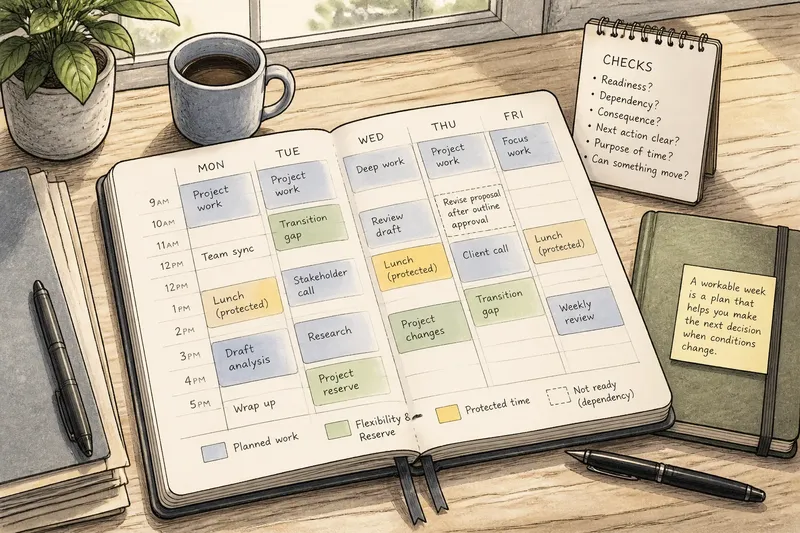
Calendar Blocks or an Open Task List: Choosing by How Predictable Work Is
Choose calendar blocks or an open task list by whether work needs a specific time, so commitments stay visible and flexible next actions remain easy to choose.

The common mistake with calendar blocks is treating every worthwhile task as if it has a known start and finish; the cost is a schedule that becomes hard to trust when work changes. Choosing between calendar blocks and an open task list is really a decision about whether a task needs a particular time or a clear place in a project’s sequence.
What should the calendar decide?
A calendar records when your attention is committed: a meeting, a class, a submission window, or a work session that depends on another person or a particular place. It is less useful for recording every action you hope to complete.
An ordered task list shows what can happen next and what must wait. It can preserve project dependencies without assigning an hour to each action before you understand what doing it will involve.
Use both tools, but give each one a distinct job. Let the calendar hold appointments and genuine time constraints; let the list show the sequence of available project actions.
When does a calendar block fit?
Choose a block when timing is part of the work. If a collaborator is available only at a particular time, or a quiet room can be used only during a set window, the calendar records a real constraint rather than a guess.
A block can also protect repeatable work when its purpose is clear. Reserve a session to draft a proposal, for instance, without treating the block as a promise that the entire proposal will be finished.
When the work contains unresolved questions, depends on an answer, or may expand as you learn more, avoid scheduling the whole outcome. If a reserved session would help, name a limited aim such as “identify missing information” instead.
When should work stay on an ordered list?
Use a list when the order matters more than the hour. A project may require reviewing notes before drafting, or choosing a direction before contacting a supplier; the list preserves that sequence while leaving the timing open.
Separate actions you can take from actions that are waiting on someone else. A “waiting for” heading, a flag in Todoist, or a note in a paper notebook can make the dependency visible without disguising it as available work.
Make each listed action concrete enough to begin. “Work on the report” hides the decision; “compare the two proposed outlines” identifies a next move. Order ready, consequential actions ahead of ideas that still need clarification.
How do you choose between a calendar block and a task list?
Does the task have a fixed appointment?
Put the appointment on the calendar because the time itself is part of the commitment. Add preparation or travel only when it is genuinely required, and keep unrelated work out of the surrounding space.
Is the task important but its duration unclear?
Keep it on the list until you can name a bounded session or a specific next action. If you need protected time to clarify it, reserve a session for that limited question rather than for the whole outcome.
Does the work depend on someone else?
List the action you can take now and record what you are waiting for separately. Put a shared conversation on the calendar only when you and the other person have agreed on a time.
Does the week contain fixed duties and shifting project work?
Record fixed duties and true timing constraints on the calendar, then order movable project actions on a list. That separation makes it easier to choose available work when the week changes.
How can the two tools support a project without duplicating it?
Use the calendar to answer, “When is my attention committed?” Use the list to answer, “What can I choose next?” Copying every list item into calendar slots creates two records to maintain and makes ordinary changes look like failures.
Say you are preparing a presentation, and the content depends on a colleague’s comments. You already have an agreed meeting time, but the comments have not arrived; list “sort comments into themes” and “revise the opening” as later actions, while the calendar holds only the meeting. If the comments are late, the visible result is that the appointment remains clear and you can choose another ready action instead of treating the revision as a missed calendar commitment.
If you move a calendar entry, decide whether it represents a firm commitment or a preferred time. A fixed appointment needs a new agreed time; a flexible work session can return to the list until a suitable opportunity appears.
What should you change when your calendar blocks keep shifting?
Repeatedly moved blocks may be a sign that the task has no real timing constraint. Return it to the list, then make its next action specific enough to choose when you have an opening.
If the list is long and interruptions keep changing your priorities, identify which constraints are genuine: a person’s availability, access to a shared document, or a deadline. Put only the time-dependent commitments on the calendar; clarify or reorder the remaining actions on the list.
For calendar blocks or an open task list, the useful distinction is whether the work depends on a particular time or on readiness and sequence. When a project changes, update that distinction rather than forcing every action into a slot. The calendar can then show what is spoken for while the list preserves the next decisions still available to you.