From To-Do Lists to the Next Visible Action
Turn a vague to-do list into next visible actions: write tasks you can start, recognize progress, and leave open-ended projects easier to resume.
The common mistake with a to-do list is writing the project name where an action belongs: “work on the proposal” sits beside “send the invoice,” as if both were equally ready to begin. For open-ended work, that vague entry costs more than a tidy list can repay: each time you return to it, you must first figure out what it means. A next visible action turns the item into something you can observe yourself doing, such as opening the draft and marking the sections that still need evidence.
Consider a deliberately hypothetical situation. Mara has a small community garden project on her list, alongside paid work and household tasks. The garden idea is still taking shape; she is not ready to commit to a design, but she wants to make some progress without spending the week repeatedly deciding what “work on the garden” means.
Why does “work on the garden” stay on the list?
Mara’s original entry sounds like a task, but it names a territory, not an action. It could mean checking the site, comparing planting ideas, contacting a neighbor, sketching beds, or deciding whether the project is viable. Each possibility asks for a different tool, setting, and kind of attention.
That ambiguity creates a small decision at the moment Mara is trying to start. If she has only a short opening, the phrase gives no clue whether the work fits; if she has more time, it still does not tell her what to do first. The list preserves the intention but leaves the starting point hidden.
The same pattern appears in many open-ended projects. “Improve the onboarding,” “sort the family photos,” and “plan the workshop” can each contain several branches of work. They are useful as project labels, but they make unreliable next actions until one branch becomes visible.
Mara does not need to decide the whole garden plan before taking a useful step. She needs to identify one action that can begin with what she already knows, while keeping the unresolved choices available for later.
What counts as a next visible action?
A next visible action describes a concrete move and leaves a clue about what completion looks like. “Look into shade” is still broad; “open the site photos and mark the corners that stay shaded” names an object, an action, and an observable result. Mara can tell when that small move is done without pretending the garden itself is finished.
“Visible” does not mean the action must produce a public deliverable. A private note, a marked-up photograph, a short list of questions, or a draft paragraph can make progress observable. The point is to replace a foggy intention with a startable move, not to turn every thought into paperwork.
For Mara, a first pass at rewriting the entry might produce:
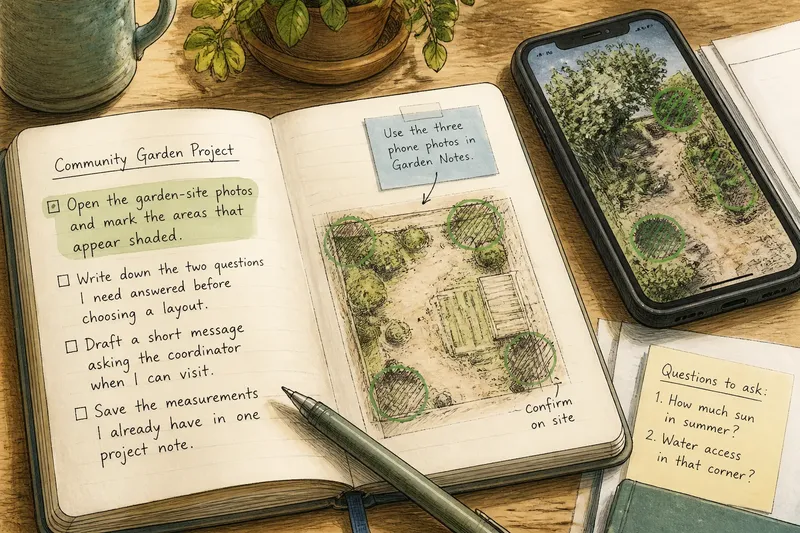
- Open the garden-site photos and mark the areas that appear shaded.
- Write down the two questions she needs answered before choosing a layout.
- Draft a short message asking the garden coordinator when she can visit.
- Save the measurements she already has in one project note.
These are candidate actions, not promises to complete them all. The list now exposes different kinds of work: observing, clarifying, asking, and organizing. Mara can choose among them based on what is available, rather than having to rediscover the project each time.
How does Mara choose a useful first move?
She looks for an action that reduces uncertainty without forcing a decision she is not ready to make. Because she has photos but no confirmed visit, marking likely shade is available now. Choosing plants would be premature: it depends on conditions she has not checked, and it would disguise an unanswered question as a decision.
Mara picks the photo action and writes it in a paper notebook next to the project name. She adds a small cue: “Use the three phone photos in Garden Notes.” That cue matters because “mark the shaded areas” could itself become a search task if she cannot remember where the pictures are.
Imagine Mara has a quiet half hour before an appointment and opens the notebook. She finds the photos in the named phone album, circles the corners that look shaded, and writes “confirm on site” beside one uncertain area. The expected observable result is not a finished design; it is an annotated set of photos and a specific question to resolve at the next visit.
That result gives the next action somewhere to come from. Mara can now ask about the uncertain corner during a visit, or draft the coordinator message if arranging access comes first. The first move has not narrowed every option; it has made the remaining options easier to see.
How small should the action be?
An action is small enough when Mara can picture its opening move and recognize its stopping point. “Research garden layouts” does not pass that test: it could lead into endless browsing. “Save two layout sketches that fit the site’s narrow entrance” is more bounded, though Mara should only use it once she has enough site information to make that comparison meaningful.
Small does not mean trivial. A short action can clear a real obstacle, while an elaborate task may only make the list look impressive. A useful rewrite tends to answer three practical questions: What will I touch or open? What will I do with it? What will exist when I stop?
If an action still feels hard to begin, Mara can expose the hidden first move. “Draft a message” might become “open a blank email and write the subject line and greeting.” That is not busywork if starting the message is the actual obstacle; it is an honest description of the work in front of her.
But shrinking a task can go too far. “Find notebook” may be a poor list entry if the notebook is already on the desk and the meaningful work is deciding what to ask. The aim is not to split everything into tiny fragments; it is to remove the uncertainty that makes an item resistant to starting.
What if the next action depends on an answer?
Some project moves must wait. Mara cannot confirm the shaded corner until she visits, and she cannot choose a layout responsibly until she understands the site. Rather than leave a vague item in the active list, she records the dependency plainly: “At the garden visit, check the shaded corner.”
She also keeps the available action separate: “Message the coordinator to arrange a visit.” This distinction prevents a waiting point from masquerading as work she can do now. If the message is sent, the next visible move is to wait for a reply; it is not to keep rewriting the same email in her head.
When the next action depends on a label, manufacturer instructions, or local rules, those sources determine the relevant details; the general practice is to name the source and the question rather than guess. For Mara’s garden, local growing guidance may matter later, but it does not need to be settled before she marks what she can already observe.
Keeping dependencies visible also protects the project from false urgency. A blocked action can remain on the project note with its trigger, while the active next action stays something Mara can actually begin. She does not have to erase an option just because it is not available today.
How can a next visible action stay useful?
A rewritten action can become stale when new information arrives. After Mara visits the garden, “check the shaded corner” is no longer a future action; she can replace it with what the visit revealed and choose a new move. The list is a working surface, not a contract to follow old wording after the situation changes.
She can keep a compact record in one place: the project name, the current next action, any waiting point, and a few open questions. A plain notebook page, a note in Apple Notes, or a simple task in Todoist can all work. The useful choice is the one Mara will consult when she returns to the project, not the one with the most elaborate structure.
A quick wording check helps before she leaves an item on the list:
- Does it begin with an action verb?
- Can I identify the object, document, person, or place involved?
- Can I picture the first move without making another plan first?
- Will I know what changed when I stop?
- Does the action depend on something that is not available yet?
If an item fails one of these checks, Mara can revise only what is unclear. She might add the file name, name the person to contact, or mark the dependency. She need not rewrite every project entry just to make the list look consistent.
Which questions help turn a vague list into action?
What is the difference between a project and a next action?
A project names an outcome that requires multiple decisions or actions, such as creating a garden plan. A next action names one observable move that advances it, such as annotating site photos or asking the coordinator about access.
Can a next action be a question or a conversation?
Yes, if it names what you will do: “Ask the coordinator whether the shaded corner can be visited” is startable. “Find out about the site” is less useful because it does not say whom to ask or what information matters.
What should I write when I cannot start yet?
Record the action that is blocked and what it depends on, then choose a separate action that is available now. “Check shade during the visit” can remain visible while “send a message to arrange the visit” becomes the current move.
How often should I rewrite task-list items?
Rewrite an item when it no longer tells you what to do, or when new information changes the next move. Rewording every entry on a fixed schedule can add maintenance without making the project easier to begin.
What changes by the end of Mara’s walk-through?
Mara began with a broad intention, “work on the garden,” and ended with an annotated set of photos, an unresolved site question, and a clear message she can send to arrange a visit. In this invented situation, the project has not been completed, and no single action settles its design. What changes is the distance between opening her list and knowing what to do.
The useful lesson is not that every task needs to be broken into smaller tasks. It is that an open-ended project benefits from one visible action at its current edge, with the other options and dependencies still in view. A good next visible action gives a person a place to begin without claiming to know the whole route.
When “work on the garden” returns to Mara’s list, she can treat it as the project heading, not as a failed task. The next visible action is the line she can pick up: concrete enough to start, modest enough to finish, and clear enough to leave the project easier to resume.